

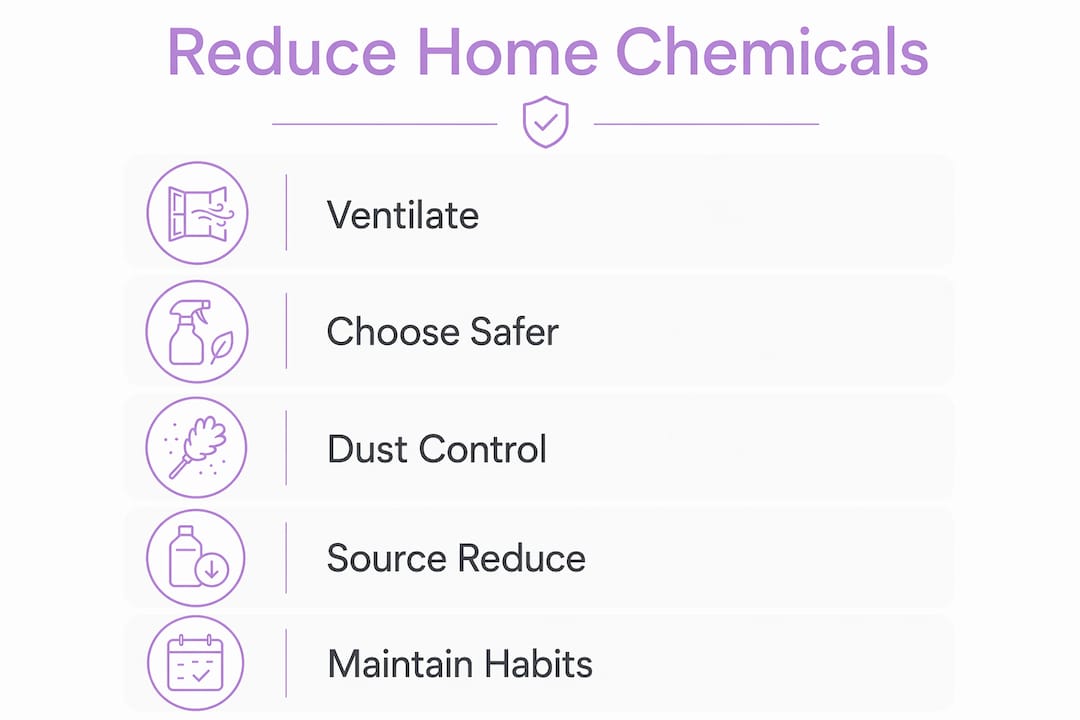
Chemical exposure at home is defined as regular contact with synthetic compounds found in cleaning products, furniture, dust, and fragranced items that accumulate indoors and affect long-term health. The EPA and environmental toxicologists confirm that indoor air often contains higher concentrations of volatile organic compounds (VOCs), flame retardants, and synthetic fragrances than outdoor air. Families can reduce chemical exposure at home through four proven strategies: improving ventilation, choosing safe cleaning products, controlling dust, and cutting off chemical sources at the door. None of these steps require a complete lifestyle overhaul. Each one delivers real, measurable results on its own.
How does improving ventilation reduce chemical exposure indoors?
Ventilation is the most effective strategy for lowering indoor VOC concentrations. It works by diluting trapped chemical compounds with fresh outside air, which reduces the total amount your family breathes in each day. The fix costs nothing and takes minutes.
VOCs build up indoors because homes are sealed tightly for energy efficiency. Cooking, cleaning, and off-gassing furniture all release compounds that have nowhere to go without active air exchange. Opening windows and running exhaust fans breaks that cycle.
Here are the most effective ventilation habits to build:
- Open windows on opposite sides of your home for cross-ventilation. Even 10 minutes creates meaningful air exchange.
- Run kitchen exhaust fans during and after cooking. Gas stoves release nitrogen dioxide and carbon monoxide in addition to VOCs.
- Use bathroom fans during and for 30 minutes after showering to remove moisture and product chemicals.
- Ventilate after cleaning. Spray cleaners, floor products, and disinfectants all release chemicals into the air. Open a window immediately after use.
- Air out dry-cleaned clothes in a garage or outdoors before bringing them inside. Dry-cleaning solvents off-gas for hours.
Indoor air quality improves fastest through a combination of ventilation and source reduction, not air purifiers alone. An air purifier helps, but it cannot replace fresh air exchange.
Pro Tip: Try “house burping” every morning. Open two windows on opposite ends of your home for 10 minutes before the day starts. This single habit flushes overnight chemical buildup from off-gassing furniture, bedding, and personal care products.
What safe cleaning products and methods minimize chemical exposure?
The cleaning aisle is one of the biggest sources of indoor chemical exposure, and most families use far more products than they need. Consolidating your cleaning routine to a small set of verified, safer products cuts exposure significantly.
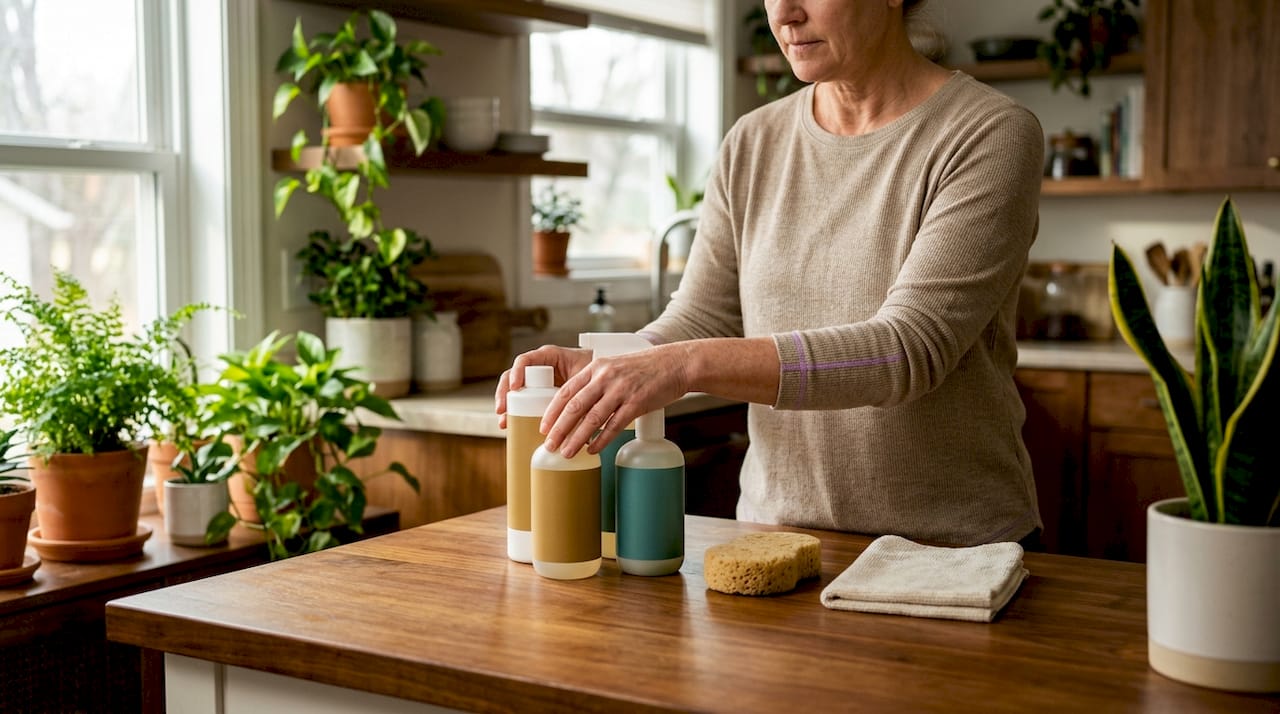
The EPA endorses hydrogen peroxide (3%+), ethanol (70%+), and citric acid (0.5%+) as effective disinfecting agents that carry a much lower chemical risk than quaternary ammonium compounds (quats). Quats are found in many conventional disinfectant sprays and wipes and are linked to respiratory irritation and skin sensitization. Switching away from them is one of the highest-impact product changes a family can make.
Fragranced products are the other major problem. Scented consumer products contain hidden chemical mixtures that contribute to indoor air pollution and increase chemical body burden over time. “Fragrance” on a label can represent dozens of undisclosed compounds. Fragrance-free alternatives cut that exposure immediately.
When selecting products, look for these certifications:
- EPA Safer Choice label: confirms every ingredient meets safety standards for human health and the environment.
- Green Seal certified: an independent standard covering both performance and chemical safety.
- EWG Verified: the Environmental Working Group’s mark for products free from chemicals of concern.
You can also check the types of non-toxic cleaners available for every room in your home before making a switch.
Practical product swaps that work:
- Replace multi-surface sprays with a single EPA Safer Choice all-purpose cleaner.
- Use reusable microfiber cloths instead of disposable wipes treated with preservatives.
- Swap scented dish soap for fragrance-free versions with simple ingredient lists.
- Clean glass with diluted white vinegar and water instead of ammonia-based sprays.
Pro Tip: Reduce the number of cleaning products you own to five or fewer. More products mean more chemical combinations and more exposure. One all-purpose cleaner, a toilet bowl cleaner, a dish soap, a laundry detergent, and a scrub cover nearly every cleaning need in a home.
How can regular cleaning and dust control reduce household toxins?
Household dust is not just dirt. It carries flame retardants, plastic additives, and microfibers shed from furniture, electronics, and textiles. Children are most at risk because they spend time on floors and put their hands in their mouths. Controlling dust is one of the most direct ways to eliminate household toxins from your family’s daily environment.
The method matters as much as the frequency. Feather dusters and dry cloths move contaminated particles into the air, where they stay suspended for hours before resettling. Damp dusting and vacuuming with sealed HEPA filters actually remove the particles from your home.
Follow this cleaning sequence for maximum chemical reduction:
- Damp dust all surfaces first. Use a damp microfiber cloth on shelves, windowsills, and electronics. This traps particles rather than launching them airborne.
- Vacuum with a sealed HEPA filter vacuum. Standard vacuums exhaust fine particles back into the air. A sealed HEPA system captures them.
- Vacuum upholstered furniture weekly. Sofas and chairs accumulate flame retardants from foam padding and release them into dust.
- Run a robotic vacuum on a daily schedule. Robotic vacuums used consistently reduced measurable chemical presence in household dust and air within about 10 weeks in a controlled study. The consistency matters more than the device.
- Prioritize bedrooms and children’s rooms. These are the spaces where families spend the most time in direct contact with surfaces and off-gassing materials.
Pro Tip: Clean from top to bottom, always. Dust falls. If you vacuum the floor first and then wipe shelves, you contaminate the floor again. Top-to-bottom cleaning cuts your total cleaning time and prevents recontamination in one step.
What lifestyle and product choices help eliminate common chemical sources?
Source reduction is the most underrated strategy for lowering indoor chemical levels. It addresses the root cause of contamination rather than cleaning up after it. Removing shoes at the door is the single most cost-free, high-impact habit a family can adopt. Shoes track in pesticides, heavy metals, and chemical residues from outdoor surfaces. A no-shoes policy stops that contamination before it enters your home.
New furniture and mattresses require special handling. VOC off-gassing peaks in the first days after purchase. Airing these items in a garage or outdoors before bringing them inside prevents trapping high chemical concentrations in your living space. For mattresses, this step is especially worth doing since you spend 7–8 hours in direct contact with the material every night.
PFAS (per- and polyfluoroalkyl substances) are another source worth addressing. These chemicals appear in stain-resistant fabric treatments, non-stick cookware coatings, and water-repellent textiles. They do not break down in the body or environment, which is why they are called “forever chemicals.” Choosing PFAS-free cookware and untreated textiles removes a significant ongoing exposure.
| Chemical source | Where it hides | Reduction strategy |
|---|---|---|
| VOCs | New furniture, paint, flooring | Air out before indoor use |
| PFAS | Non-stick cookware, stain-treated fabric | Switch to cast iron or ceramic |
| Flame retardants | Foam furniture, electronics | Damp dust and HEPA vacuum regularly |
| Pesticide residues | Shoe soles, tracked-in dirt | No-shoes policy at the door |
| Synthetic fragrance | Candles, air fresheners, fabric softener | Replace with fragrance-free alternatives |
Scented candles, plug-in air fresheners, and fabric softener sheets are common sources of hidden chemical exposure that families rarely question. Switching to fragrance-free laundry products and eliminating synthetic air fresheners removes dozens of compounds from your indoor air without any sacrifice in cleanliness.
How to maintain and troubleshoot reduced chemical exposure habits at home?
Sustaining a lower-chemical home is easier than building one. The most common mistake families make is backsliding on fragrance. A new scented candle or a “fresh linen” fabric spray can undo weeks of progress in a single afternoon. Fragrance is the easiest chemical exposure to eliminate and the easiest to reintroduce without noticing.
Reviewing product labels every few months keeps your routine honest. Formulations change, and a product that was fragrance-free last year may have added a “masking fragrance” in its latest version. Look for the EPA Safer Choice or EWG Verified mark as a shortcut when you do not have time to read every ingredient.
Beware of greenwashing. Products labeled “natural,” “green,” or “plant-based” may still contain harmful ingredients. Verified certifications like EPA Safer Choice, Green Seal, and EWG Verified are the only reliable signals of actual chemical safety. A pretty label with leaves on it means nothing without third-party verification.
If someone in your home experiences sudden chemical inhalation, move them to fresh air immediately, open all windows, and contact Poison Control (1-800-222-1222 in the United States) if symptoms persist. Do not wait to see if symptoms resolve on their own.
Common habits that undermine progress:
- Using scented plug-ins or air fresheners to mask odors instead of ventilating.
- Buying “green” products without checking for verified certifications.
- Skipping ventilation during and after cleaning because it feels inconvenient.
- Neglecting dust control in bedrooms while focusing only on kitchen and bathrooms.
Pro Tip: Make one change per week rather than overhauling everything at once. Start with the bedroom since that is where you spend the most hours. Replace one scented product, add a ventilation habit, or switch to a certified cleaner. Small, consistent changes compound into a genuinely lower-tox home over a few months.
Key takeaways
Reducing indoor chemical exposure requires consistent ventilation, verified product choices, and dust control habits focused on the rooms where your family spends the most time.
| Point | Details |
|---|---|
| Ventilation is the first priority | Open windows daily and run exhaust fans during and after cooking and cleaning. |
| Choose certified products | Look for EPA Safer Choice, Green Seal, or EWG Verified labels to avoid greenwashing. |
| Dust control removes real toxins | Damp dust and HEPA vacuum regularly, especially in bedrooms and children’s rooms. |
| Source reduction beats cleanup | Remove shoes at the door and air out new furniture before bringing it inside. |
| Fragrance is a hidden exposure | Switching to fragrance-free products cuts indoor pollutant levels without sacrificing cleanliness. |
The goal is not a chemical-free home. It is a lower-risk one.
I have seen families spend hundreds of dollars on air purifiers while still using heavily fragranced fabric softener and synthetic candles every day. The purifier does almost nothing against what the candle puts back in. That mismatch is the most common mistake I encounter, and it comes from a reasonable but flawed assumption: that you can buy your way to a cleaner home without changing habits.
The honest truth is that a completely chemical-free home is not achievable, and chasing that goal leads to expensive, exhausting decisions. What is achievable is a meaningfully lower-exposure home, built on a handful of consistent habits. Ventilation costs nothing. Removing shoes costs nothing. Switching from a scented cleaner to a fragrance-free certified one costs the same or less.
Bedrooms and children’s rooms are where I always tell families to start. You spend a third of your life in your bedroom. If you only make one change this month, make it there. Air out that mattress, swap the scented laundry detergent, and open the window every morning. That alone moves the needle more than most people expect.
The greenwashing problem is real and worth taking seriously. I have read labels on products marketed as “pure,” “natural,” and “clean” that contained synthetic fragrance and quats. Certifications like EPA Safer Choice and EWG Verified exist precisely because marketing language cannot be trusted. Use them as your filter, not the color of the packaging.
— Gimmi
What Jermaphobi4me offers for a healthier home
Jermaphobi4me is built around one idea: clean environments produce healthier people. If you are ready to act on what you have read here, the Jermaphobi4me resource library is a practical next step.

The site covers safe cleaning product guidance for every room, from kitchen disinfection to laundry alternatives, with clear explanations of certifications and ingredients to avoid. You will also find a detailed breakdown of how to eliminate harmful cleaning chemicals from your current routine without replacing everything at once. For families making their first changes, the Jermaphobi4me store carries products selected with the same standards described in this guide.
FAQ
What is the fastest way to reduce indoor chemical exposure?
Ventilation is the fastest and lowest-cost method. Opening windows and running exhaust fans immediately dilutes indoor VOC concentrations without any product purchase required.
Are “natural” cleaning products actually safer?
Not automatically. Products labeled “natural” or “green” may still contain harmful ingredients due to greenwashing. Look for EPA Safer Choice, Green Seal, or EWG Verified certifications for reliable safety assurance.
How does household dust expose families to chemicals?
Household dust carries flame retardants, plastic additives, and PFAS shed from furniture and textiles. Damp dusting and vacuuming with a sealed HEPA filter removes these compounds rather than redistributing them.
Does removing shoes at the door actually make a difference?
Yes. Removing shoes at the door prevents pesticides, heavy metals, and chemical residues from outdoor surfaces from entering your home. It is one of the most effective source reduction steps available at zero cost.
When should I air out new furniture or a mattress?
Air out new furniture and mattresses outdoors or in a garage before bringing them inside. VOC off-gassing peaks in the first days after purchase, so pre-conditioning before indoor use prevents trapping high chemical concentrations in your living space.
Recommended
- Eliminate Harmful Cleaning Chemicals: Your 2026 Guide – Gimmi Vitality Products dba Jermacilin Store
- What Is Chemical-Free Cleaning? A Practical Guide – Gimmi Vitality Products dba Jermacilin Store
- Types of Non-Toxic Home Cleaning Products: 2026 Guide – Gimmi Vitality Products dba Jermacilin Store
- Why Cleaning Products Cause Allergies: What to Know – Gimmi Vitality Products dba Jermacilin Store