

An eco-friendly cleaner is a cleaning product formulated to minimize harm to the environment and human health by using safer ingredients and reducing hazardous impacts throughout its lifecycle. The term “green cleaning” is the recognized industry phrase for this practice, and understanding what it actually means separates smart shoppers from those misled by packaging. No single federal law defines what qualifies as eco-friendly, which is exactly why certifications from bodies like the EPA and Green Seal matter so much. At Jermaphobi4me, we believe a clean home should never come at the cost of your health or the planet.
What does eco-friendly cleaner mean, exactly?
An eco-friendly cleaner reduces environmental harm at every stage of its life, from the ingredients sourced to the water it enters after rinsing down your drain. The EPA warns consumers that vague terms like “eco safe” and “green” on packaging carry no legal weight. Without a verified standard behind them, those words are marketing, not facts.
The core criteria that define a genuinely green cleaner include biodegradability, low aquatic toxicity, minimal volatile organic compounds (VOCs), and responsible packaging. Biodegradability means the product breaks down naturally in water systems without leaving harmful residues. Low VOC content matters because many conventional cleaners release gases that pollute indoor air long after you finish scrubbing.
The FTC Green Guides reinforce this point sharply. The FTC warns marketers that unqualified “eco-friendly” claims imply broad environmental benefits that manufacturers rarely fully substantiate. That means a product labeled “eco-friendly” without specific supporting evidence may legally qualify as deceptive advertising.
What certifications verify a truly green cleaner?
Third-party certifications are the most reliable way to verify an eco-friendly claim. The EPA Safer Choice label evaluates every ingredient in a product for both human health safety and environmental performance. It does not just look at the finished formula. It examines each component individually.
Green Seal is another credible standard. Green Seal certification requires products to meet strict limits on hazardous ingredients, packaging waste, and manufacturing practices. Both Safer Choice and Green Seal go far beyond what any front-label marketing claim can promise.
Key criteria these certifications evaluate include:
- Ingredient safety: Each chemical must pass toxicity and biodegradability assessments.
- Aquatic impact: Ingredients must not persist in waterways or harm aquatic life.
- VOC limits: Products must stay below thresholds that affect indoor air quality.
- Packaging standards: Recycled content and reduced plastic are often required.
- Transparency: Manufacturers must disclose full ingredient lists to the certifying body.
Pro Tip: Look for the Safer Choice or Green Seal logo on the back of the bottle, not just the front. Front labels are marketing. Back labels are where verified claims live.
Ecolabels are a better indicator of greenness than any front-label claim, precisely because they require documented evidence rather than a manufacturer’s word.
How do eco-friendly, non-toxic, and natural cleaners differ?
These three terms sound interchangeable. They are not, and confusing them leads to real purchasing mistakes.
| Label | Primary focus | Regulated? | What it does NOT guarantee |
|---|---|---|---|
| Eco-friendly | Environmental impact | No federal standard | In-home human or pet safety |
| Non-toxic | Human health safety | No federal standard | Environmental biodegradability |
| Natural | Ingredient origin | No federal standard | Safety, performance, or eco impact |
Eco-friendly addresses what happens to a product in the environment, such as how it behaves in waterways and soil. Non-toxic addresses what happens inside your home, specifically whether a product irritates skin, lungs, or eyes. Natural simply describes where an ingredient came from, not what it does to you or the planet.
A product can be biodegradable and gentle on ecosystems but still cause skin irritation or respiratory reactions indoors. That is not a contradiction. It reflects two separate safety dimensions that each require separate evaluation.
The American Academy of Pediatrics advises verifying product safety through recognized third-party logos like Safer Choice or Green Seal rather than trusting green labeling alone. This is especially relevant for households with children, pets, or anyone with respiratory sensitivities.
Pro Tip: When shopping for eco-friendly cleaning products, run two separate checks. First, confirm the environmental credentials with a certification logo. Second, review the ingredient list for known irritants like synthetic fragrances or strong acids.
What are the real benefits of eco-friendly cleaning products?
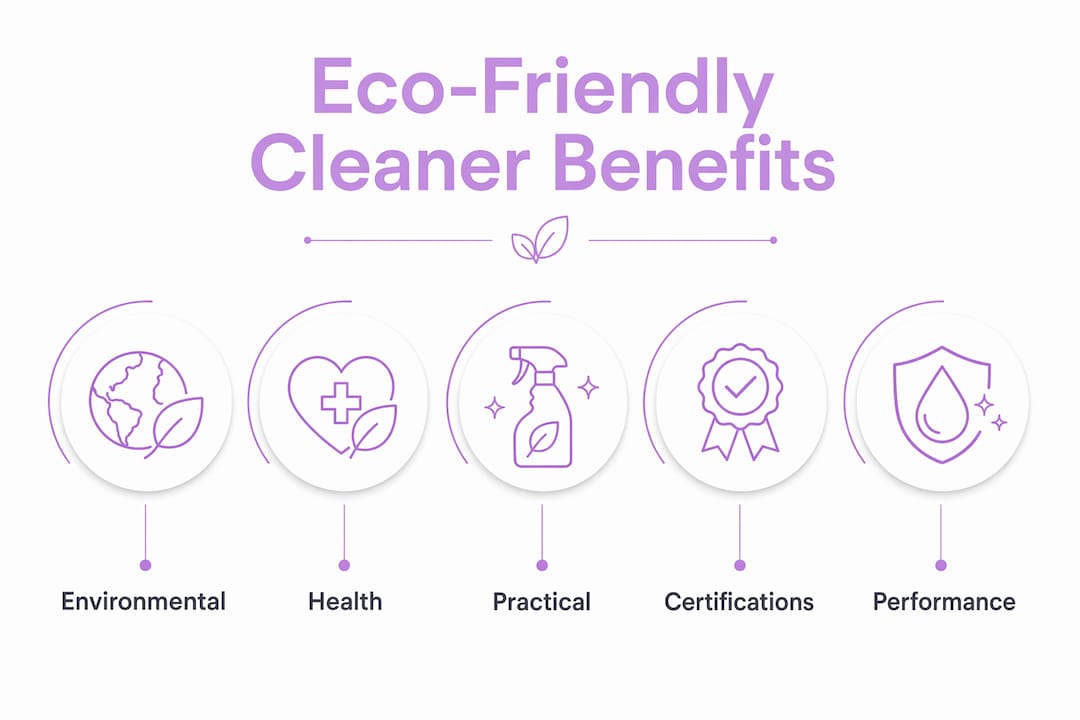
The benefits of eco-friendly cleaners fall into three clear categories: environmental, health, and practical.
Environmental benefits are the most documented. Research on green cleaning protocols showed a nearly 48% reduction in greenhouse gas emissions compared to conventional cleaning systems. That reduction came alongside significant cuts in chemical consumption and waste. The finding matters because it proves green cleaning is not just a feel-good choice. It produces measurable results.
Health benefits center on what you are not breathing or absorbing. Eco-friendly cleaning products reduce exposure to irritating chemicals and minimize hazardous waste, directly improving indoor air quality. Conventional cleaners often contain ammonia, chlorine bleach, and synthetic fragrances that linger as airborne particles. Switching to certified green alternatives cuts that chemical load significantly.
“Using eco-friendly products contributes to a healthier indoor environment and reduces environmental pollution from cleaning chemicals.” — EPA
Practical benefits are often overlooked. Many certified green cleaners perform on par with conventional products for everyday tasks. You can learn more about verifying cleaning product safety before you buy to match the right product to the right job. Safer disposal is another practical win. Products with biodegradable formulas are safer to pour down the drain without contributing to water pollution.
How to choose truly eco-friendly cleaners for your home
Choosing a genuinely green cleaner requires a short but deliberate verification process. Consumers who skip this step often end up paying a premium for products that are no safer or greener than conventional options.
Follow these steps every time you evaluate a new product:
- Look for a third-party certification logo. Safer Choice, Green Seal, or EcoLogo on the label means an independent body has verified the claims. A logo on the back panel carries more weight than words on the front.
- Match the product to your cleaning task. EPA Safer Choice certifies products by category, such as disinfectants, degreasers, and general surface cleaners. A certified all-purpose cleaner is not a substitute for a certified disinfectant when you need one.
- Read the ingredient list. Avoid products that list “fragrance” without disclosure, as that single word can mask dozens of undisclosed chemicals. Look for plant-derived surfactants and skip anything with phosphates or chlorinated solvents.
- Be skeptical of unqualified claims. Words like “eco-safe,” “plant-based,” and “green formula” without a certification logo are unverified. The FTC Green Guides require specific, substantiated evidence for any environmental claim.
- Check packaging. Concentrated formulas in recyclable or refillable containers reduce plastic waste significantly. This is part of the full lifecycle assessment that genuine eco-friendly products consider.
Consumers who build this verification habit consistently make better purchasing decisions. Skepticism toward unqualified marketing is not cynicism. It is the practical skill that separates a genuinely healthier home from one that just looks green on the shelf.
You can also explore chemical-free cleaning concepts to understand how ingredient transparency connects to both eco-friendly and personal care product choices.
Key Takeaways
Eco-friendly cleaners are verified by third-party certifications like EPA Safer Choice and Green Seal, not by front-label marketing claims, and they address environmental impact separately from in-home human safety.
| Point | Details |
|---|---|
| Definition requires verification | “Eco-friendly” has no federal legal definition; rely on Safer Choice or Green Seal logos. |
| Eco-friendly is not non-toxic | A product can be biodegradable but still irritate skin or lungs indoors. |
| Certifications check ingredients | EPA Safer Choice evaluates every ingredient individually for safety and environmental performance. |
| Green cleaning delivers results | Research shows green cleaning protocols can cut greenhouse gas emissions by nearly 48%. |
| Greenwashing is common | FTC Green Guides warn that unqualified eco-friendly claims are often deceptive without specific evidence. |
What I have learned from years of watching people shop green
The biggest mistake I see is people treating “natural” as the gold standard. They pick up a bottle with leaves on the label and assume it is the safest option in the aisle. Natural ingredients can absolutely be irritating, allergenic, or even toxic in concentrated form. Lemon oil, for example, is natural and can cause skin photosensitivity. Tea tree oil is natural and toxic to pets at certain concentrations.
What I have found actually works is treating certification logos the way you treat nutrition labels on food. You would not buy a product claiming to be “healthy” without checking the label. The same logic applies here. Safer Choice and Green Seal exist precisely because the marketing language on cleaning products is unreliable without them.
The other thing I want to push back on is the idea that eco-friendly cleaners are a compromise on performance. The research on green cleaning protocols shows measurable environmental gains without sacrificing hygiene. The gap between green and conventional performance has closed considerably as formulation science has improved. You do not have to choose between a clean home and a responsible one.
My honest recommendation is to start with one product category, say your kitchen surface cleaner, find a Safer Choice certified option, and test it for a month. Once you see that the performance holds up, expanding to other categories feels natural. Small, verified swaps build real habits. Wholesale overnight switches based on front-label marketing rarely stick.
— Gimmi
Safer cleaning products, curated for your home
Jermaphobi4me carries a selection of cleaning and hygiene products built around the same principles this article covers: ingredient transparency, verified safety, and real performance.
The top-selling product collection features options with cleaner ingredient profiles designed for everyday home use. For those who want a practical starting point, the Hand Hygiene Starter Kit offers travel-sized eco-conscious options that are easy to test before committing to a full switch. Every product in the Jermaphobi4me lineup reflects the brand’s core belief: a clean environment and a healthy person are not competing goals. They go together.
FAQ
What does eco-friendly cleaner mean in simple terms?
An eco-friendly cleaner is a product formulated to reduce harm to the environment through safer ingredients, biodegradability, and lower chemical pollution. The term has no single federal definition, so third-party certifications like EPA Safer Choice are the most reliable way to verify the claim.
Are eco-friendly cleaners as effective as conventional ones?
Research on green cleaning protocols shows they can match conventional cleaners on hygiene while producing nearly 48% fewer greenhouse gas emissions. Matching the right certified product to the right cleaning task is the key to getting full performance.
What is the difference between eco-friendly and non-toxic cleaners?
Eco-friendly refers to a product’s environmental impact, such as biodegradability and aquatic safety. Non-toxic refers to in-home human safety. A product can qualify as one without qualifying as the other, so checking both dimensions separately is necessary.
How do I spot greenwashing on cleaning product labels?
The FTC Green Guides warn that unqualified claims like “eco-safe” or “green formula” without specific evidence are potentially deceptive. Look for a named third-party certification logo rather than relying on front-label language alone.
Is “natural” the same as eco-friendly or non-toxic?
No. “Natural” describes ingredient origin and is an unregulated term with no safety or environmental standard behind it. Some natural ingredients cause irritation or are toxic to pets, so natural labeling alone does not confirm a product is eco-friendly or safe for home use.
Recommended
- What Is Chemical-Free Cleaning? A Practical Guide – Gimmi Vitality Products dba Jermacilin Store
- What Is a Safe Cleaning Product? Your 2026 Guide – Gimmi Vitality Products dba Jermacilin Store
- How to Disinfect Your Kitchen Without Harsh Bleach – Gimmi Vitality Products dba Jermacilin Store
- Why Cleaning Products Cause Allergies: What to Know – Gimmi Vitality Products dba Jermacilin Store